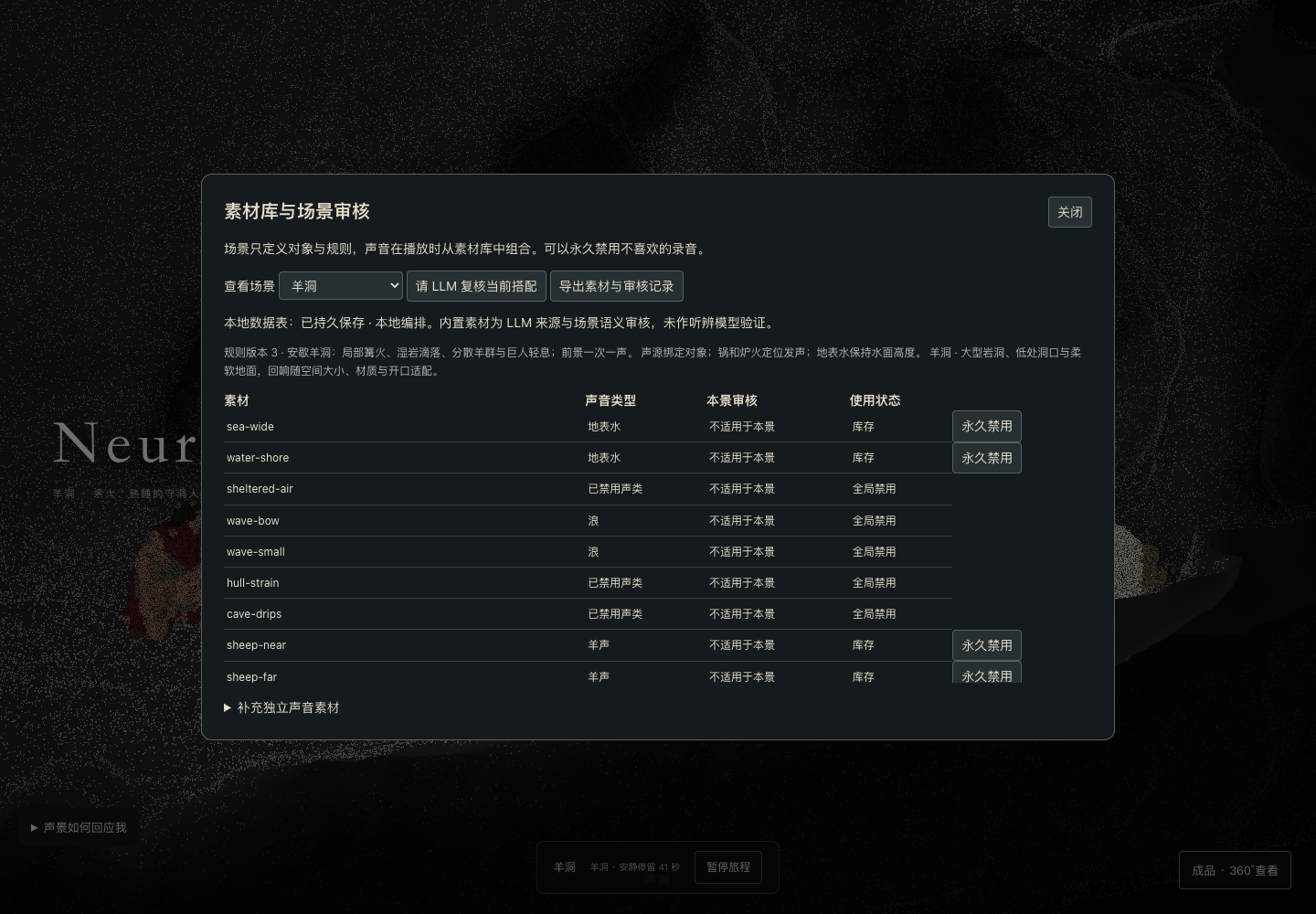
Physiologically responsive soundscapes must accommodate changing control signals while maintaining the identities and consequences of audible events. NeuroJourney is a macOS prototype that separates persistent world processes from their adaptive acoustic presentation.
A scene is authored through source identities, support regions, process dependencies and a sparse cue budget. An EEG interface supplies quality-gated vendor indices for branch selection, permitted motion and bounded audio control. Local and optional cloud planners submit recordings to a common executor that checks admissibility before and after asynchronous preparation.
Two artistic cases develop the approach: a cave whose inhabitants are disclosed through distributed cues, and a rainy shelter whose vessel progresses from heating to serving. Evaluation combines 34 contract checks, controlled component ablations, scene traces and archived digital renders.